
Clean Touch Ink Pads
How clean touch ink pads work
Why mess-free, no-touch ink pads are gentler on newborn skin — and how to get a perfect first handprint or footprint on the very first try.
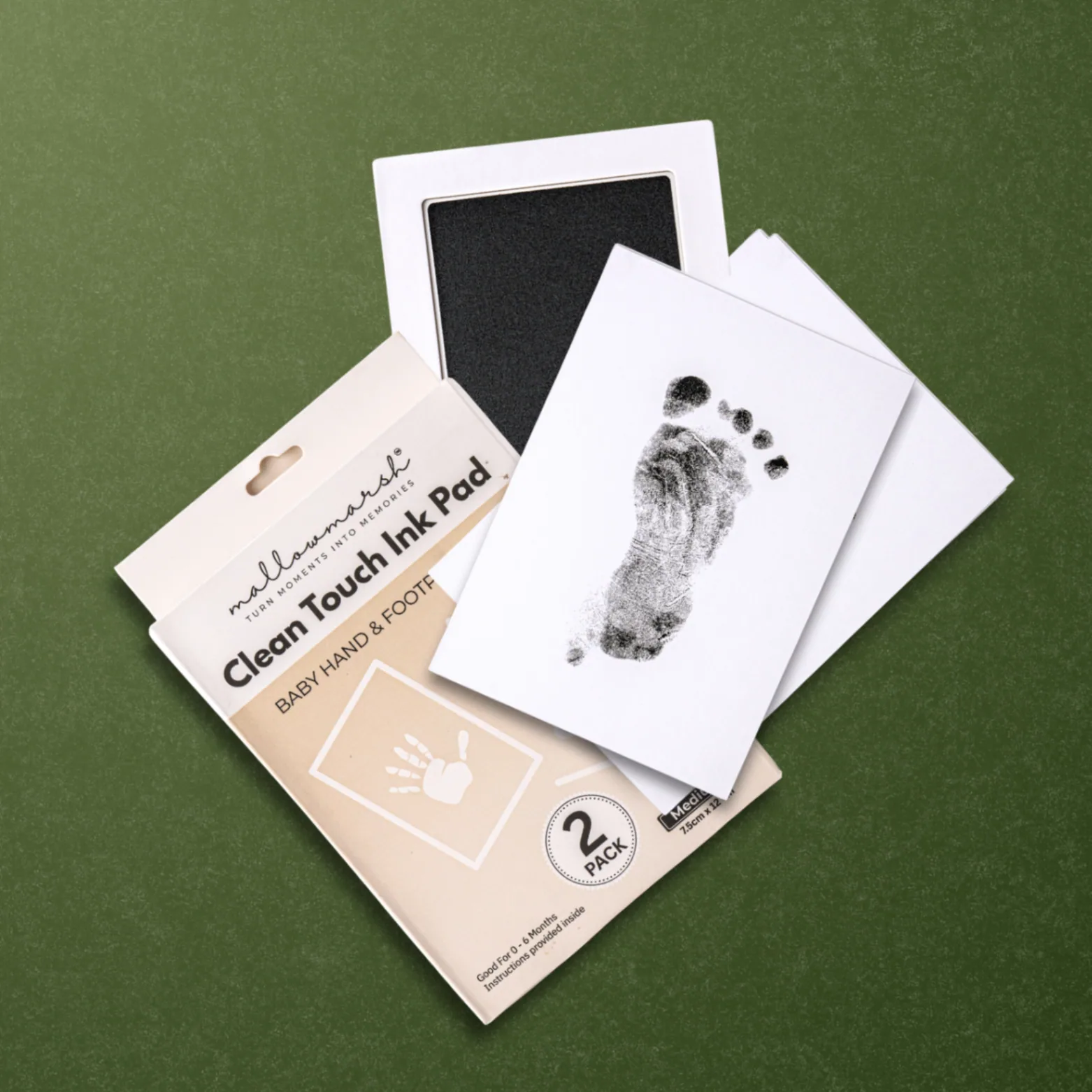
The first time you try to capture a newborn print with a traditional ink pad, two things become obvious: the baby will not cooperate, and the ink will end up everywhere. Clean touch ink pads were designed to solve both at once.
The first time you try to capture a newborn print with a traditional ink pad, two things become obvious: the baby will not cooperate, and the ink will end up everywhere. Clean touch ink pads were designed to solve both at once.
Footprints from the hospital are usually too smudged or too dark. Most parents only get one chance at a true newborn print before the foot grows past it — by week six, the curve has changed entirely. A clean, no-touch pad gives you that chance at home, on your own time, on the keepsake page that will hold it for the next forty years.
How it works
A clean touch ink pad is layered. The ink lives sealed inside the pad — never on the surface you touch. You press baby's hand or foot onto the clean outer cover, then press that cover onto paper. The print appears, sharp and detailed, without a single drop of ink touching baby's skin.
A perfect first print, in five steps
- Wait until baby is calm, drowsy, or asleep.
- Do a test press on scrap paper to check the print intensity.
- Press baby's foot or hand firmly and evenly onto the cover for 2–3 seconds.
- Lift cleanly — no sliding — and place the cover face down onto your keepsake page.
- Press across the back evenly with the heel of your hand, then peel up.
Timing your prints: a small calendar
Newborn feet and hands change shape faster than parents expect. These are the milestones most worth capturing — and the windows in which they look most like themselves:
- Day 1–14. The true newborn print. Tiny, curled, unmistakable. Don't wait.
- 1 month. The foot has straightened slightly. Worth a second print for comparison.
- 6 months. Hands now have visible palm lines. Footprints are noticeably wider.
- First birthday. A walking foot. Side-by-side with the newborn print, this is the spread parents most often frame.
Troubleshooting the most common issues
- The print came out faded or patchy
- The press wasn't firm or long enough. Try a full 3 seconds with the heel of your hand. Make sure the paper is on a hard, flat surface — a cookbook or hardback novel underneath works.
- The print smudged
- The foot slid as you lifted. Always lift straight up, perpendicular to the paper — no rolling, no dragging. A second pair of hands helps for older babies.
- Baby curled their toes
- Stroke the top of the foot gently — most newborns relax their toes within a few seconds. If they're awake and active, try again after a feed when they're drowsy.
- The pad seems dry
- A short rest between prints helps the ink redistribute. Close the pad fully between uses so the sealed surface stays even.
A quiet moment, not a project
First-time parents sometimes psych themselves out — set up a whole station, recruit a partner, save it for a special weekend. The prints that come out best are almost always the ones taken in five minutes, on a Tuesday afternoon, while the baby is half-asleep on a changing mat. The pad rewards a quiet hand more than a careful plan.
Where to use it
Most parents use clean touch ink pads in baby memory books, on keepsake cards for grandparents, or framed in the nursery. The MallowMarsh™ Clean Touch Ink Pad is built specifically to work with the MallowMarsh™ Pregnancy Journal, so the print lands directly on a pre-designed spread inside the baby memory book half — no cutting, no rearranging.
Related reading
- The complete guide to pregnancy journals
- Baby memory books, demystified
- Keepsake gifts for expecting moms
Frequently asked
- How does a clean touch ink pad work?
- The ink stays sealed inside a layered pad. You press baby's hand or foot onto the cover (which has no visible ink), then press the cover onto paper to reveal a clean, detailed print. Baby's skin never touches the ink itself.
- Are clean touch ink pads safe for newborns?
- Yes. Because the ink is sealed inside the pad, it never makes contact with baby's skin. The MallowMarsh™ pad uses water-based, non-toxic, acid-free ink and is designed for ages 0+ — so it's safe from day one in the hospital.
- What's the best way to get a perfect first print?
- Wait until baby is calm or asleep. Press the foot or hand firmly and evenly onto the pad cover for 2–3 seconds, then onto paper without sliding. Do a test print on scrap paper first.
- Can I use a clean touch ink pad in any baby memory book?
- Yes — the prints transfer to standard paper, so they work in any baby memory book or journal. Some keepsakes, like the MallowMarsh™ Pregnancy Journal, include the ink pad and pre-built print pages together.
- When is the best age to take newborn handprints and footprints?
- The first two weeks capture the smallest, most newborn-shaped prints. But anytime in the first six months is wonderful — feet especially change week to week. Many parents take prints at birth, one month, six months, and the first birthday for a single comparison spread.
- Why does my print look smudged or incomplete?
- Three common causes: the foot slid during the press (lift straight up, never drag), the paper wasn't fully supported underneath (use a hardback book under the page), or the press was too light. The pad rewards a firm, even, two-second press over a quick one.
- How many prints can I get from one pad?
- The MallowMarsh™ Clean Touch Ink Pad produces roughly 30 clean prints per pad, and the kit includes two pads and six imprint cards. That's enough for keepsake spreads plus extras for grandparents, frames, and the inevitable retake.
- Will the ink fade over time?
- The water-based, acid-free ink is designed to stay sharp on archival paper for decades. To protect prints from sun fading, frame them under UV-filtering glass or keep the keepsake book closed when not being read.